
As an Amazon Associate I earn from qualifying purchases. This post contains affiliate links.
Quick Answer: Coffee affects sleep less through how much you drink and more through when. Caffeine has a half-life of roughly 5-7 hours, so a cup at 3 PM can still leave measurable caffeine in your bloodstream at 10 PM. For most people going to bed around 11 PM, the safest cutoff is 1-3 PM. Even if you fall asleep easily after a late coffee, caffeine can still reduce deep sleep and delay REM sleep – so sleep quality suffers even when duration doesn’t.
Modern coffee culture has turned caffeine into more than a morning ritual. It’s fuel for deadlines, creativity, remote work sessions, gym motivation, late-night studying, and endless scrolling under dim apartment lights. Coffee sits beside laptops during midnight productivity bursts, powers early gym sessions before sunrise, and follows millions of people through almost every hour of the day.
Yet many people still underestimate one thing: timing.
Most coffee drinkers focus on how much caffeine they consume, but sleep scientists increasingly point to a different issue – when caffeine is consumed may matter just as much as how strong the coffee is. A single late-afternoon espresso can quietly reduce sleep quality hours later, even if someone falls asleep “normally.”
Caffeine affects the brain long after the energy boost disappears. It alters sleep pressure, delays melatonin release, changes REM sleep patterns, and can interfere with the body’s circadian rhythm in surprisingly subtle ways. For some people, the effects linger deep into the night without them even realizing it.
Understanding how caffeine affects sleep isn’t about quitting coffee. It’s about learning how timing changes everything.

Why Caffeine and Sleep Have Such a Complicated Relationship
Coffee feels immediate. Sleep problems usually don’t.
That delay is one reason people often fail to connect the two.
A person might drink coffee at 4 PM, feel completely fine by evening, and still struggle with fragmented sleep at midnight. Another person may drink espresso after dinner and fall asleep instantly – yet wake up exhausted the next morning because sleep architecture was disrupted beneath the surface.
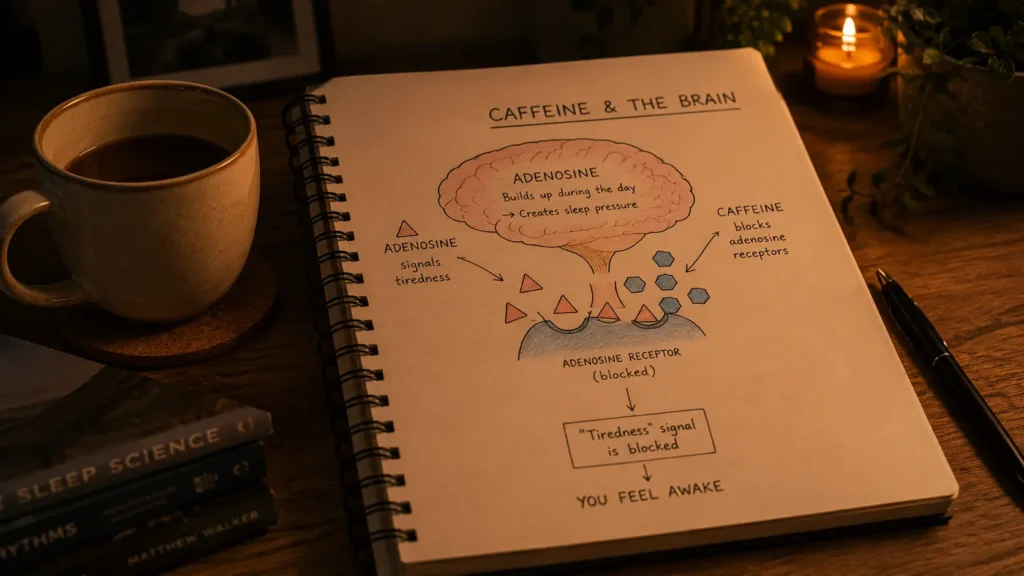
Caffeine works by interfering with one of the brain’s most important biological systems: adenosine signaling.
Adenosine is a neurotransmitter that gradually builds throughout the day. The longer you stay awake, the more adenosine accumulates in the brain, increasing what scientists call “sleep pressure.” This is the biological sensation of feeling tired.
Caffeine blocks adenosine receptors.
Instead of removing tiredness, caffeine essentially masks the brain’s ability to detect fatigue.
That distinction matters.
The body may still need rest, but the brain temporarily loses access to the signal telling it to slow down.
This is why caffeine can create the illusion of restored energy even during sleep deprivation.
What Happens in the Brain After Drinking Coffee?
Within about 15 to 45 minutes after consumption, caffeine enters the bloodstream and crosses the blood-brain barrier.
From there, several neurological effects begin:
- Adenosine receptors become blocked
- Dopamine signaling slightly increases
- Alertness rises
- Reaction time improves
- Fatigue perception decreases
- Cortisol and adrenaline may temporarily rise
This creates the classic feeling people associate with coffee:
mental sharpness, focus, motivation, and wakefulness.
But the brain also pays a price for artificial alertness.
Because adenosine continues accumulating underneath the caffeine blockade, many people later experience what feels like a sudden “crash.” In reality, the tiredness was delayed rather than removed.
Why Coffee Sometimes Makes People More Tired
One of the most confusing experiences for coffee drinkers is feeling sleepy after caffeine.
There are several scientific explanations for this:
1. Adenosine Rebound
Once caffeine begins wearing off, the accumulated adenosine floods receptors all at once. This can create intense fatigue.
2. Poor Sleep Debt
People often use caffeine to compensate for chronic sleep deprivation. Over time, the body becomes exhausted beneath the stimulant effect.
3. Blood Sugar Fluctuations
Sugary coffee drinks may cause spikes and crashes in blood glucose, contributing to fatigue.
4. Caffeine Tolerance
Frequent caffeine consumption reduces sensitivity. The stimulating effect weakens while dependency increases.

Understanding Caffeine Half-Life
One of the most important concepts in sleep science is caffeine half-life.
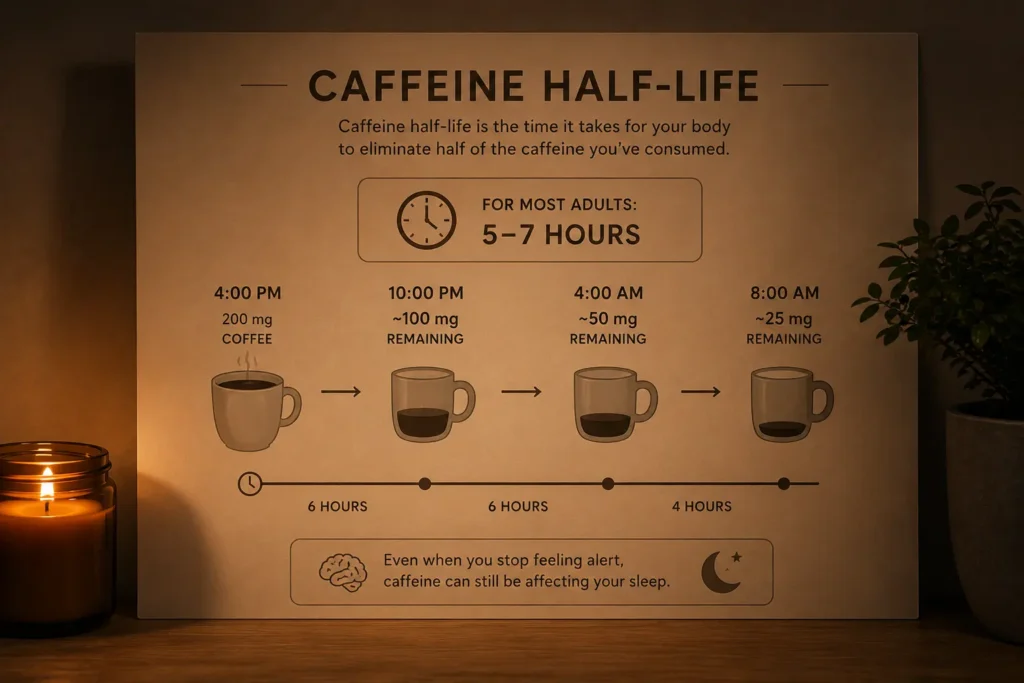
Caffeine half-life refers to the amount of time required for the body to eliminate half of the caffeine consumed.
For most adults, caffeine has a half-life of roughly 5 to 7 hours.
That means:
- A coffee consumed at 3 PM may still leave significant caffeine in the bloodstream at 10 PM
- A strong energy drink at 6 PM can affect sleep past midnight
- Evening espresso may continue influencing REM sleep long after falling asleep
Many people think caffeine “wears off” once they stop feeling energized. Physiologically, this is often false.
The stimulating sensation fades earlier than the actual neurological impact.
For example:
A 200 mg coffee consumed at 4 PM could still leave around:
| Time After Drinking Coffee | Approximate Caffeine Remaining |
|---|---|
| 4 PM | 200 mg |
| 10 PM | 100 mg |
| 4 AM | 50 mg |
For sensitive individuals, that is more than enough to affect sleep quality.
Why Some People Can Drink Coffee at Night and Sleep Fine
Everyone knows someone who drinks espresso after dinner and claims to sleep perfectly.
Genetics partially explain this.
Caffeine metabolism varies dramatically between individuals due to liver enzymes, particularly CYP1A2.
Some people are fast metabolizers.
Others are slow metabolizers.
Fast metabolizers process caffeine more efficiently, meaning the stimulant leaves their system faster.
Slow metabolizers may feel caffeine effects for much longer periods.
This difference helps explain why caffeine tolerance discussions online often become confusing. Two people can drink identical coffee amounts and experience completely different sleep outcomes.
Factors That Affect Caffeine Sensitivity
Several variables influence caffeine metabolism:
- Genetics
- Age
- Stress levels
- Sleep quality
- Hormonal changes
- Medication use
- Body mass
- Smoking status
- Pregnancy
- Frequency of caffeine consumption
People with anxiety disorders may also experience stronger stimulant responses.
For highly sensitive individuals, even morning coffee can affect nighttime sleep.

How Caffeine Changes Sleep Quality
One of the biggest misconceptions about caffeine is that sleep only matters if someone struggles to fall asleep.
But sleep quality matters just as much as sleep duration.
Research shows caffeine may:
- Reduce deep sleep
- Delay REM sleep
- Increase nighttime awakenings
- Lower sleep efficiency
- Delay melatonin production
- Shift circadian rhythm timing
Even when someone falls asleep quickly, sleep architecture can still become fragmented.
That means a person may technically sleep eight hours but wake up feeling mentally foggy and physically drained.
REM Sleep and Caffeine
REM sleep is strongly connected to:
- memory consolidation
- emotional regulation
- learning
- creativity
- cognitive recovery
Late caffeine intake may reduce REM sleep quality.
This becomes especially relevant for:
- students
- knowledge workers
- creatives
- gamers
- remote workers
- people in cognitively demanding jobs
Ironically, people often consume caffeine to improve performance while simultaneously damaging the sleep needed for long-term cognitive function.

The Circadian Rhythm Connection
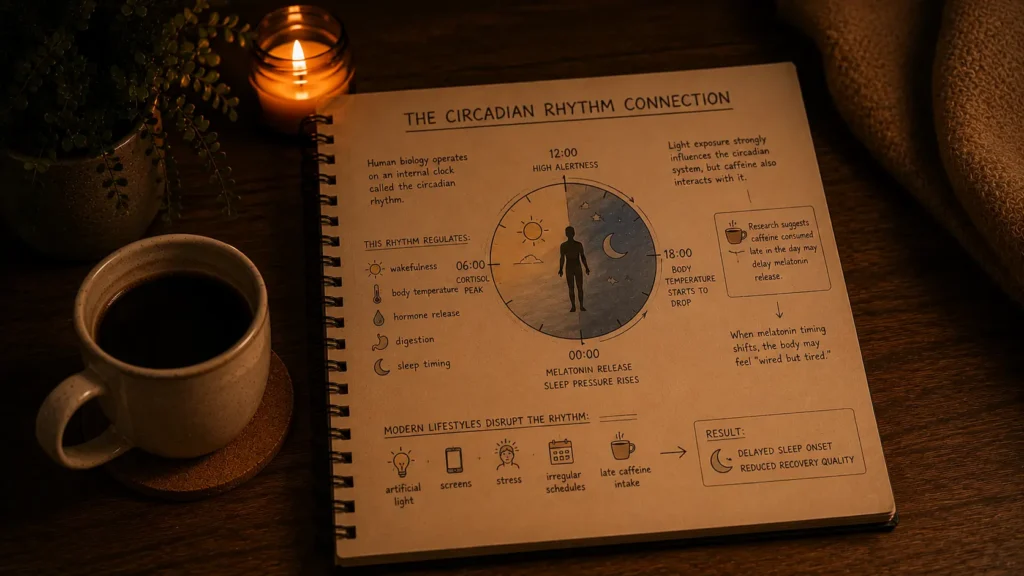
Human biology operates on an internal clock called the circadian rhythm.
This rhythm regulates:
- wakefulness
- body temperature
- hormone release
- digestion
- sleep timing
Light exposure strongly influences the circadian system, but caffeine also interacts with it.
Research suggests caffeine consumed late in the day may delay melatonin release.
Melatonin is the hormone signaling the body that nighttime has arrived.
When melatonin timing shifts, the body may feel “wired but tired.”
This is increasingly common in modern digital lifestyles where people combine:
- artificial light
- screens
- stress
- irregular schedules
- late caffeine intake
The result is often delayed sleep onset and reduced recovery quality.
The Science Behind Morning Coffee Timing
For years, many people believed coffee should be consumed immediately after waking up.
Sleep researchers now question that habit.
Cortisol – the body’s natural alertness hormone naturally peaks shortly after waking. ( Interesting scientific paper, but it’s pretty boring haha )
Drinking caffeine immediately upon waking may:
- interfere with natural alertness rhythms
- increase dependency
- worsen afternoon crashes
Some experts suggest waiting 60 to 90 minutes after waking before drinking coffee.
Healthy morning coffee rituals may support more stable energy levels throughout the day
This timing may better align with natural cortisol fluctuations.
Best Time to Drink Coffee for Energy and Sleep Balance
While individual biology varies, many sleep specialists recommend:
- First coffee: 60–90 minutes after waking
- Last caffeine intake: 8–10 hours before bedtime
| Coffee Timing | Potential Sleep Impact |
|---|---|
| Within 15 minutes after waking | May interfere with natural cortisol rhythm |
| 60–90 minutes after waking | Often considered ideal timing |
| After 3 PM | Increased risk of sleep disruption |
| Evening caffeine | High likelihood of affecting REM sleep |
For someone sleeping at 11 PM, this often means avoiding caffeine after 1–3 PM.
Of course, metabolism matters. Sensitive individuals may require earlier cutoffs.

Hidden Sources of Caffeine Most People Ignore
Coffee gets blamed most often, but caffeine appears in many overlooked products.
Common hidden caffeine sources include:
- Matcha
- Green tea
- Black tea
- Dark chocolate
- Protein bars
- Pre-workout supplements
- Energy drinks
- Some medications
- Soda
- Yerba mate
- Kombucha
- Certain flavored waters
Many people unintentionally stack caffeine throughout the day
Understanding how much caffeine in a cup of coffee can help people better manage their daily intake and sleep quality
A morning latte, afternoon tea, evening soda, and pre-workout supplement may combine into a surprisingly high total intake.
How Much Caffeine Is Too Much?
General guidelines often suggest:
- Up to 400 mg daily for healthy adults ( I came across this great source that explains it in much more detail. )
But optimal intake varies dramatically.
Some people experience sleep disruption at:
- 50–100 mg
Others tolerate significantly more.
Sleep quality should ultimately guide consumption habits more than generic averages.
Coffee Culture and the Modern Sleep Crisis
Modern culture rewards stimulation.
Coffee has become symbolic of:
- productivity
- ambition
- hustle culture
- optimization
- late-night work
- constant availability
Social media aesthetics reinforce this image:
espresso beside glowing keyboards, café work sessions, midnight editing marathons, “rise and grind” routines.
But biologically, humans still require consistent sleep recovery.
Caffeine can temporarily override exhaustion signals, but it cannot replace actual restoration.
This creates a dangerous cycle:
- poor sleep
- increased caffeine use
- worse sleep quality
- stronger dependency
Many people normalize chronic fatigue because everyone around them feels tired too.
Caffeine Myths vs Facts
| Myth | Fact |
|---|---|
| “I can fall asleep after coffee, so caffeine doesn’t affect me.” | Sleep quality may still be reduced even if falling asleep feels normal. Caffeine can disrupt deep sleep and REM sleep without fully preventing sleep onset. |
| “Espresso has more caffeine than drip coffee.” | Espresso is more concentrated per ounce, but a full cup of drip coffee often contains more total caffeine overall. |
| “Decaf contains zero caffeine.” | Most decaf coffee still contains small amounts of caffeine, which may affect highly sensitive individuals. |
| “Coffee dehydrates you severely.” | Moderate coffee consumption generally contributes to daily fluid intake and does not cause severe dehydration in most people. |
| “Caffeine gives the body real energy.” | Caffeine mainly blocks adenosine receptors, reducing the perception of fatigue rather than creating biological energy. |
| “Drinking coffee late only matters if you can’t fall asleep.” | Late caffeine intake can still reduce sleep quality, deep sleep, and REM sleep even if a person falls asleep quickly. |
| “People build complete immunity to caffeine.” | Tolerance can develop, but caffeine may still affect sleep architecture, nervous system activity, and recovery quality. |
| “Dark roast coffee always has more caffeine.” | Roast level does not directly determine caffeine content. Brewing method, bean type, and serving size matter more. |
| “Tea is always lower in caffeine than coffee.” | Some teas, especially matcha and strong black tea, can contain surprisingly high caffeine levels. |
| “A caffeine crash means the caffeine completely left your body.” | A crash often happens because blocked adenosine suddenly becomes active again, while caffeine may still remain in the bloodstream for hours. |
Signs Your Coffee Timing May Be Hurting Sleep
Many caffeine-related sleep issues appear subtle.
Warning signs include:
- waking up tired despite enough sleep
- nighttime racing thoughts
- afternoon crashes
- dependence on multiple coffees daily
- difficulty waking without caffeine
- frequent nighttime awakenings
- feeling “wired” late at night
- reduced dream recall
- weekend oversleeping
People often blame stress alone while overlooking caffeine timing entirely.
How to Improve Sleep Without Quitting Coffee
The goal is not necessarily caffeine elimination.
For many people, smarter timing creates dramatic improvements.
Practical Strategies
1. Create a Caffeine Cutoff Time
Set a consistent afternoon cutoff based on bedtime.
2. Reduce “Emergency Caffeine”
Using caffeine only when exhausted often worsens long-term sleep cycles.
3. Avoid Double-Dosing
Energy drinks plus coffee plus pre-workout can silently overload the nervous system.
4. Try Lower-Caffeine Brewing Methods
Some brewing styles naturally contain less caffeine.
Many specialty coffee enthusiasts also use a coffee scale to improve brewing consistency and extraction control
5. Experiment With Decaf Evenings
Decaf rituals can preserve comfort without major stimulant effects.
6. Improve Sleep Foundations
Caffeine becomes more disruptive when combined with:
- stress
- irregular schedules
- excessive screen exposure
- poor sleep hygiene
The Future of Coffee and Sleep Awareness
The conversation around coffee is changing.
For years, caffeine discussions focused mainly on productivity and performance. Increasingly, people now care about recovery, nervous system regulation, mental clarity, and sustainable energy.
Wearables, sleep trackers, and modern health research are making hidden sleep disruption more visible.
Many coffee drinkers discover:
- they don’t need less coffee
- they need better timing
That distinction changes everything.
The future of coffee culture may become less about maximum stimulation and more about intentional consumption.
FAQ
Yes. Caffeine may reduce deep sleep and REM sleep quality even if you fall asleep quickly.
Most sleep experts recommend avoiding caffeine at least 8–10 hours before bedtime.
This may happen due to adenosine rebound, poor sleep debt, caffeine tolerance, or blood sugar fluctuations.
Not necessarily, but waiting 60–90 minutes after waking may better support natural cortisol rhythms.
Caffeine stimulates the nervous system and may worsen nighttime anxiety or racing thoughts.
Decaf contains much less caffeine but usually not zero caffeine. Sensitive individuals may still notice effects.
Conclusion
Coffee is deeply woven into modern life.
It represents comfort, ritual, creativity, focus, identity, and culture. But caffeine is also a powerful neurological stimulant that interacts with the brain far longer than most people realize.
The difference between energized and exhausted often comes down to timing.
A well-timed morning coffee can enhance alertness, mood, and productivity without significantly harming sleep. Poorly timed caffeine, however, may quietly reduce recovery night after night, creating a cycle of fatigue masked by even more coffee.
Understanding caffeine and sleep timing is not about fear.
It’s about awareness.
Because better sleep and great coffee do not have to compete with each other.
They simply need better timing.
