
You can make coffee without a scale. You can also cook soup “by eye.” The real question isn’t “is it possible?” but how much control you want over taste and consistency.
A coffee scale doesn’t magically make coffee better on its own. What it does is remove guesswork. It helps you control how much coffee you use, how much water you pour, and how repeatable your brews are – especially for espresso and pour-over.
In this guide, we’ll look at when a coffee scale is essential, when it’s optional, and why so many baristas won’t brew without one.
Do You Really Need a Coffee Scale?
Short answer:
You don’t always need a coffee scale, but it becomes essential when you care about consistent, repeatable coffee – especially for espresso and pour-over. A scale lets you control coffee-to-water ratios, track your brew, and understand what actually changed when your coffee tastes different.
Most professional standards and specialty coffee guidelines such as those published by the Specialty Coffee Association (SCA) are built on specific coffee-to-water ratios, not guesses. When you measure both coffee and water, you remove a huge variable from the process. Instead of “good cup / bad cup,” you get a recipe you can repeat.
So:
- If you only drink instant coffee or capsules, you can live without a scale.
- If you’re dialing in espresso, pour-over, or drip and want consistent flavor, a scale is one of the cheapest upgrades you can make.
When a Coffee Scale Is Essential
This is where a scale stops being “nice to have” and starts being a core tool.
Espresso: Do You Need a Coffee Scale for Espresso?
If there’s one brewing method where a scale really matters, it’s espresso.
Small changes in:
- dose (how many grams of coffee you put in the portafilter)
- yield (how many grams of espresso end up in the cup)
- time
can completely change the taste.
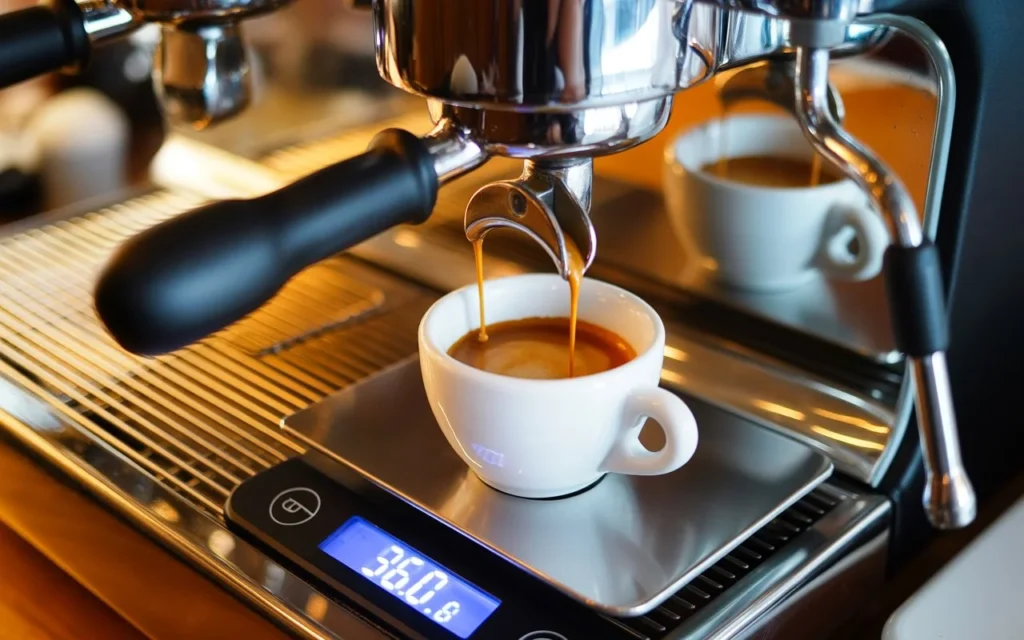
A classic starting point for espresso is:
- 18 g of ground coffee in the portafilter
- 36 g of espresso in the cup
- 25–30 seconds of extraction
This is often called a 1:2 brew ratio (one part coffee to two parts espresso).
And if you’re using high-quality beans – like the ones in our Top 10 Best Coffee Beans in the World guide – dialing in becomes even more noticeable.
Without a scale, you don’t really know if you pulled:
- 16 g in / 32 g out,
- 19 g in / 45 g out,
or something else completely. You might occasionally hit a delicious shot “by accident,” but you can’t reliably repeat it.
For home espresso, the answer to “Do I need a coffee scale for espresso?” is essentially yes. If you’re serious enough to own an espresso machine, a scale is almost mandatory to get the best out of it.
Pour-Over & Drip: Do You Need a Scale for Pour-Over or Drip Coffee?
For pour-over (V60, Chemex, Kalita, etc.) and manual drip, a scale is almost as important as it is for espresso.
Why?
These methods depend heavily on:
- the coffee-to-water ratio, and
- how much water actually hits the coffee bed.
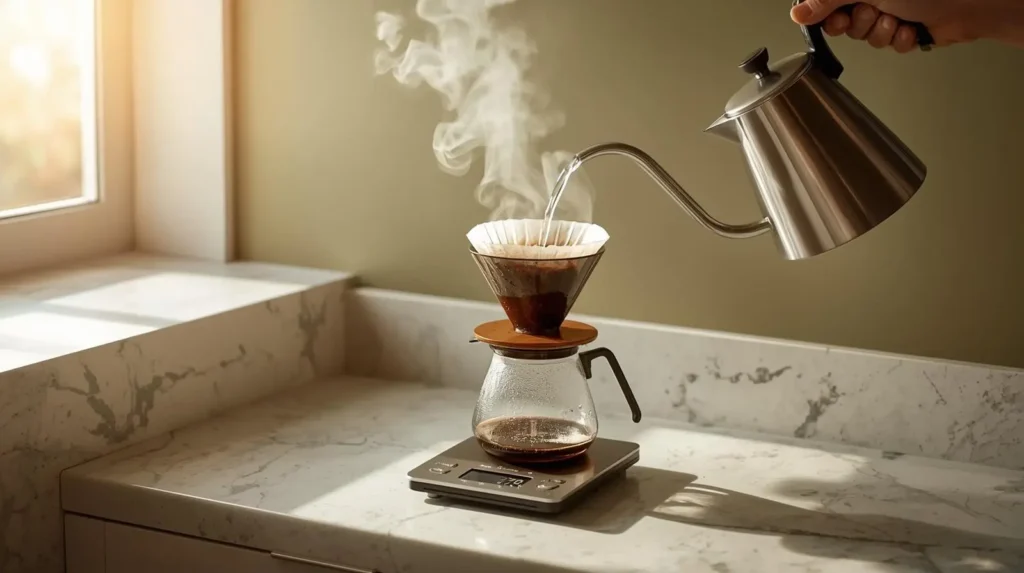
A simple pour-over recipe might look like:
- 18 g coffee
- 270 g water (a 1:15 ratio)
- total brew time around 2:30–3:00 minutes
If you’re pouring “to the line” on a kettle or “approximately to the top,” you might end up with 220 g one day and 320 g the next. The difference in flavor can be dramatic – thinner, more bitter, more sour, or just flat.
A scale:
- helps you hit the same water amount every time
- makes recipes from blogs, roasters, and baristas actually usable
- lets you tweak one variable at a time
For automatic drip machines, a scale is very helpful when you’re first dialing in how many scoops per volume of water you want. Once you’ve found a sweet spot, you can be a bit more relaxed – but having a scale to calibrate at least once is a big win.
Immersion Methods: French Press & Cold Brew
Immersion methods like French press and cold brew are more forgiving. Because steep times are longer and the brew is more relaxed, a few grams more or less won’t destroy the cup.
A scale is still useful because:
- you waste less coffee
- you can repeat a recipe more easily
- you can experiment with stronger/weaker brews and actually know what you changed
But here it’s more “quality-of-life upgrade” than “absolutely necessary”.
When You Don’t Really Need a Coffee Scale
Now to the honest part that most gear-focused articles skip.
You don’t really need a coffee scale if:
- you mainly drink instant coffee
- you use pods or capsules
- you make simple French press or immersion coffee and don’t care about fine-tuning
- you’re happy as long as there’s hot caffeinated liquid in the mug
A coffee scale is not a moral obligation. It’s a control tool.
If you don’t want to think about ratios, times, and grams at all, you can absolutely enjoy coffee without one. But if you care about taste, balance, and repeating your “perfect cup,” a scale becomes much more useful.
Coffee Scale vs No Coffee Scale: What Actually Changes
Here’s what really changes in day-to-day brewing when you introduce a scale.
| Aspect | With Coffee Scale | Without Coffee Scale |
|---|---|---|
| Coffee-to-water ratio | Precise, in grams (1:2, 1:15, etc.) | Estimated, hard to repeat |
| Taste consistency | Stable and repeatable | Different cup almost every time |
| Dialing in espresso | Easy to test small changes in dose and yield | Very hard to know what changed |
| Using expensive beans | Less waste, lower risk of ruining a great coffee | Easy to over- or under-extract |
| Learning & experimentation | You can track recipes and improve them | Feels like guessing and “luck” |
Bottom line:
Without a scale, you can drink coffee.
With a scale, you can understand your coffee and take control over how it tastes.
What Is a Coffee Scale (and How Is It Different from a Kitchen Scale)?
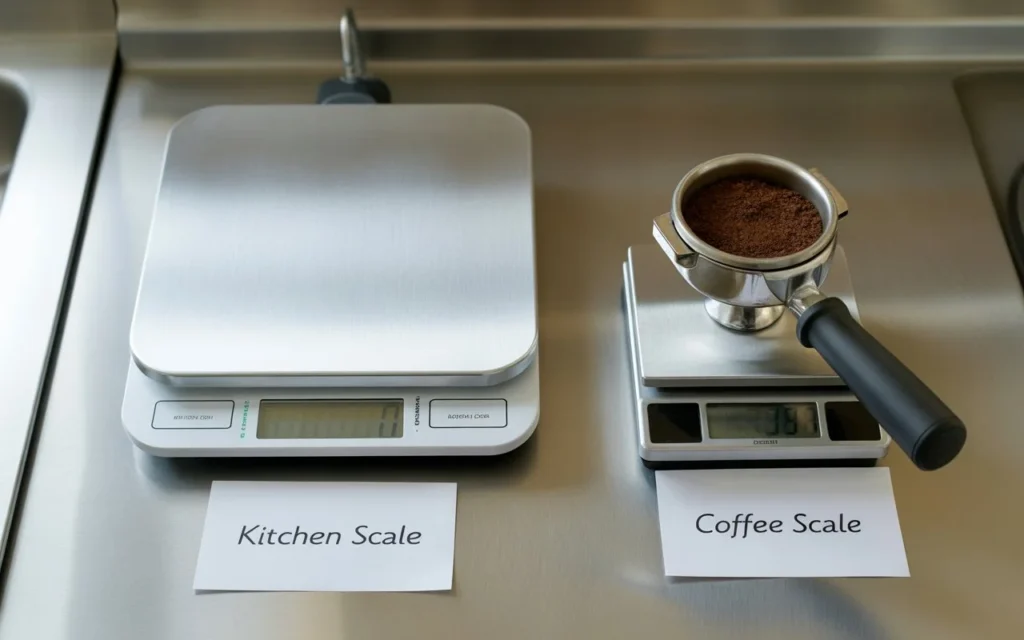
A coffee scale is a small digital scale designed specifically for brewing. Typically it has:
- higher precision (often down to 0.1 g)
- a compact platform that fits a cup, server, or portafilter
- fast response time
- often a built-in timer
A typical kitchen scale:
- usually measures in 1 g increments
- has a large platform for bowls and plates
- may react more slowly to quick changes
- is designed for larger weights (up to several kilograms)
What a coffee scale is used for:
- weighing coffee beans or grounds
- measuring espresso yield in grams, not just “volume in the cup”
- tracking how much water you pour in pour-over, French press, or drip
You can use a kitchen scale for coffee, especially for filter and immersion methods. For espresso, though, the higher precision and quicker response of a coffee scale make a big difference.
Why Use a Coffee Scale? Real Benefits, Not Just Geek Stuff
Let’s translate “it’s more precise” into what that actually means in the cup.Consistent Taste
Consistent Taste
Coffee is sensitive. Small changes in ratio can make it:
- sour and sharp
- flat and hollow
- bitter and harsh
- or balanced and sweet
A coffee scale lets you hit the same ratio every time, so once you find a recipe you like, you can repeat it instead of chasing that one “perfect cup” you accidentally made once and never found again.
Easier Espresso Dial-In
Dialing in espresso means finding the right combination of:
- dose (input, in grams)
- yield (output, in grams)
- extraction time
With a scale, your thought process becomes:
“18 g in / 36 g out in 28 seconds tasted a bit sour.
I’ll try 18 g in / 40 g out in 30 seconds and see if it tastes more balanced.”
You can change one variable at a time, instead of changing everything at once without knowing what worked.
Better Use of Expensive Beans
When you buy more expensive beans-single origin, rare varieties, delicate coffees – you usually want to taste what you paid for.
The more precise you are with dose and yield, the lower your chances of:
- under-extracting and getting a sour, hollow cup
- over-extracting and pulling bitterness out of an otherwise beautiful coffee
A scale helps you protect both your taste and your wallet.
Faster Learning Curve
If you:
- write down your recipes
- track what you changed
- pay attention to how it tastes
you learn much faster.
A scale makes that process more like a simple experiment and less like a random guess.
Why Are Coffee Scales So Expensive?
If you’ve ever looked at premium coffee scales and thought “that’s a lot for a tiny rectangle,” you’re not alone.
Here’s why many coffee scales cost more than generic kitchen scales:
- Higher precision and faster response
Coffee scales usually measure down to 0.1 g and respond very quickly – especially important when pulling espresso shots. - Heat and moisture resistance
They sit under hot cups, near steam wands, and in splash zones. They need to handle heat, moisture, and daily use. - Extra features
Built-in timers, specific espresso or pour-over modes, auto-start timing, sometimes Bluetooth and apps. - Smaller market
Coffee scales are more niche than general kitchen scales, which means less mass production and higher costs.
The good news:
You don’t need a top-tier, app-connected scale to start brewing better coffee. There are solid budget and mid-range options that do the job very well.
Can I Use a Kitchen Scale for Coffee?
Yes, you can.
- For French press, drip, cold brew, and basic pour-over, a kitchen scale is fine, especially when you’re starting.
- For espresso, a kitchen scale often feels clunky: the platform may be too big, response too slow, and precision too low.
A simple approach:
- Start with your existing kitchen scale.
- Once you get deeper into espresso or pour-over and want more control, upgrade to a compact coffee scale with 0.1 g precision.
How to Measure Ground Coffee Without a Scale
If you don’t have a scale at all, you can still improve your consistency a bit.
Option 1: Use a Consistent Scoop
- Choose one scoop (or spoon) and always use the same one.
- Over time, you’ll get a feel for how many scoops work for your preferred strength.
- If you ever get access to a scale (a friend’s house, coffee shop, etc.), you can measure how many grams your usual scoop roughly holds.
It’s not precise, but it’s better than changing spoons and cups every time
(Serious Eats — https://www.seriouseats.com).
Option 2: Use Volume Guidelines for Immersion Methods
For immersion methods like French press, you can use approximate volume guides like:
- 1 heaping tablespoon of medium-coarse coffee per ~150–180 ml of water
It won’t be exact, and taste will vary between beans and grinds, but it gives you a baseline.
Option 3: Buy a Simple Budget Scale
If you’re already thinking about how to measure coffee without a scale, you’re probably close to the point where a small digital scale will make your life much easier.
There are many compact, affordable scales that cost less than a bag of specialty coffee and dramatically improve your consistency.
How Accurate Does a Coffee Scale Need to Be?
For most home brewers:
- For filter, French press, and immersion: 0.5 g steps can work, but 0.1 g is nicer.
- For espresso: 0.1 g precision is strongly recommended, especially when dosing 16–20 g.
Accuracy is not just about the smallest number on the display – it’s also about how stable the reading is and whether the scale gives the same result when you put something on it again.
Why Do Coffee Scales Have a Timer?
Espresso and pour-over are both about time as much as about weight.
- Espresso: many recipes use a range (for example, 25–35 seconds) as a guide for good extraction.
- Pour-over: total brew time and flow rate affect extraction and taste.
A built-in timer means you’re not juggling your phone or a separate timer. You can see weight and time in one place, which makes brewing smoother and reduces the chance of mistakes.
You don’t need a timer in the scale, but once you have it, it’s hard to go back.
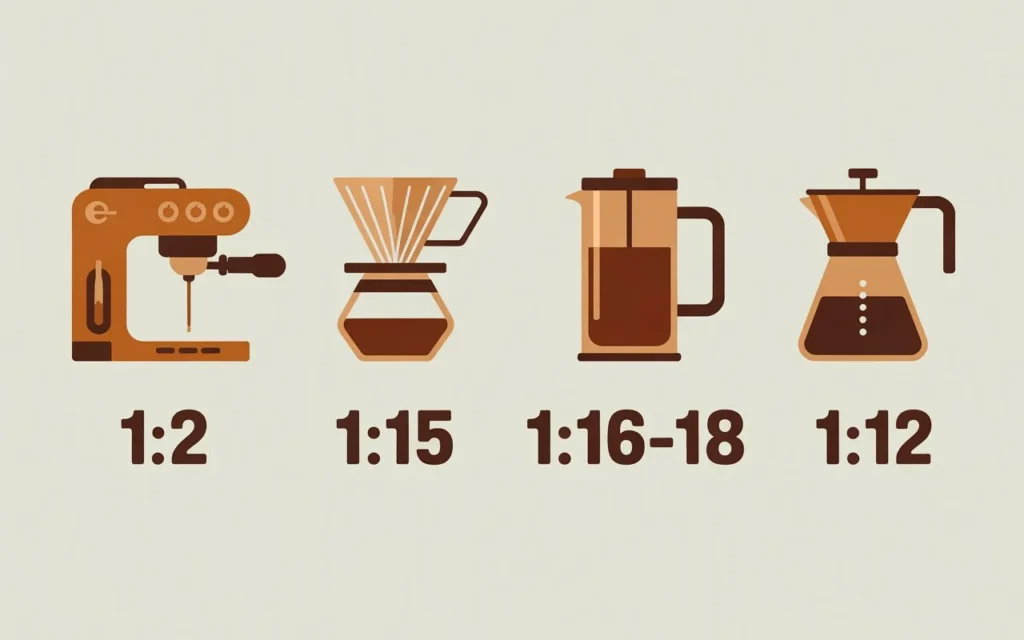
Coffee Ratios Cheat Sheet (For Beginners)
Here’s a simple reference you can use with any scale.
| Method | Coffee Dose | Water / Yield | Ratio | Notes |
|---|---|---|---|---|
| Espresso | 18 g | 36 g | 1:2 | classic “normale” shot |
| Espresso lungo | 18 g | 45-60 g | 1:2.5-1:3.3 | lighter, less intense |
| Pour-over (V60) | 15-18 g | 225–288 g | 1:15–1:16 | standard filter coffee |
| Drip coffee | 55-60 g/L | 1 L water | ~1:16-1:18 | typical “golden cup” range |
| French press | 18-20 g | 300 g | 1:15-1:17 | richer, heavier cup |
| Cold brew | 1 part coffee | 4-8 parts water | 1:4-1:8 (concentrate) | usually diluted to serve |
Best Coffee Scales for Home Use (Quick Overview)
What to Look For in a Coffee Scale
When you’re choosing a coffee scale, focus on:
- Precision: ideally 0.1 g
- Capacity: at least 1-2 kg
- Speed: fast response when weight changes
- Size: platform big enough for your cup/server, or portafilter
- Extras: built-in timer, water resistance, auto-tare (optional but nice)
Budget Coffee Scales
- Simple digital scales with 0.1 g precision
- Usually enough for filter brews and basic espresso
- Great first step if you’re on a budget
Mid-Range Coffee Scales
- Better build quality and water resistance
- Faster response times
- More comfortable for daily espresso and pour-over use
High-End Coffee Scales
- Excellent precision and responsiveness
- Often include apps, Bluetooth, advanced modes
- Amazing for enthusiasts and professionals, but not mandatory for great home coffee
How to Use a Coffee Scale (Step-by-Step)
You don’t need complicated routines. Here’s a simple way to use your scale for espresso and pour-over.
Using a Coffee Scale for Espresso
- Place the portafilter on the scale and press tare.
- Grind coffee into the portafilter until you reach the target dose (e.g. 18.0 g).
- Lock the portafilter into the machine.
- Place the cup or shot glass on the scale under the spout and press tare again.
- Start the shot and the timer.
- Stop the shot when the scale shows your target yield (e.g. 36 g).
Using a Coffee Scale for Pour-Over
- Place your server or mug with dripper on the scale and press tare.
- Add the ground coffee and note the dose (e.g. 16 g). Press tare again.
- Start your timer and begin pouring water.
- Stop pouring when the scale shows your target water amount (e.g. 240 g).
- Track total brew time and adjust grind or pouring style next time if needed.
FAQ
Technically, no. Practically, if you want your coffee to taste reliably good – and to understand why it tastes the way it does – then a scale is incredibly helpful.
If you care about consistency and flavor control, especially for espresso, pour-over, or drip, a coffee scale is one of the best upgrades you can make. If you just want a quick, simple cup and don’t plan to tweak recipes, you can manage without one.
For espresso, a scale is strongly recommended. It helps you control how much coffee goes in and how much liquid comes out, which are the foundations of dialing in a good shot.
For automatic drip coffee, you don’t need to weigh every brew forever, but a scale is very helpful when you’re first dialing in how much coffee to use for your preferred strength. Once you’ve found a ratio you like, you can use that as a baseline.
For pour-over, a scale is one of the most useful tools you can have. It helps you control both how much coffee you use and how much water you pour, which directly affects extraction and taste.
Yes. A kitchen scale works fine for many methods, especially French press, drip, and basic pour-over. For espresso and more precise brews, a compact coffee scale with higher precision and faster response will feel much better.
They’re built to be more precise, respond faster, handle heat and moisture, and often include extra features like timers and brew modes. That said, you don’t need the most expensive model to make great coffee at home.
Use a consistent scoop or spoon, stick to the same cup size, and try to keep your routine as repeatable as possible. It won’t be as precise, but it’s better than changing everything every time you brew.
Final Thoughts: Do You Need a Coffee Scale?
You don’t need a coffee scale to drink coffee.
You do, however, start needing one when you:
- want your coffee to taste consistent, not random
- want to repeat that one perfect cup you made
- want to understand what’s actually happening in your brew
For espresso and pour-over, a coffee scale is easily worth it. For French press, cold brew, and casual drip, it’s a very useful tool but not strictly required.
If you see coffee as something you want to learn, tweak, and enjoy more deeply, a scale is one of the simplest, most powerful tools you can add to your setup.
