

As an Amazon Associate I earn from qualifying purchases. This post contains affiliate links.

Quick Answer: A black latte (also called a goth latte or witch’s brew latte) is a regular latte colored inky black. To make one at home, whisk 1½ to 2 teaspoons of black cocoa powder into a hot double shot of espresso with a little sweetener, then pour in steamed milk. Black cocoa is ultra-Dutched cocoa that turns coffee deep black without the medication concerns of activated charcoal. In my tests, one tiny drop of black food gel is what takes it from dark charcoal to true jet-black.
Some coffees are meant to be pretty. This one is meant to look like it came out of a witch’s cauldron. Served in a dark mug with a pale ghost on top, it’s the most dramatic coffee you can make for Halloween.
I’ll be honest: my first attempt came out the color of dishwater. I used regular Dutch-process cocoa, just one teaspoon, and a full mug of milk, and ended up with a sad gray mocha. It took me three tries to figure out the ratio that actually looks black in the cup, and that’s the version I’m sharing here.
Served in a dark mug with a pale ghost on top, it is the most dramatic coffee you can make for Halloween.
The best part: it takes about five minutes, and you don’t need any special equipment beyond what you would use for a normal latte.
In this guide, you’ll learn which ingredient makes coffee truly black, the one ingredient I skip, a step-by-step Witch’s Brew recipe, and how to fix a latte that turns out gray instead of black.
What Makes a Latte Black?
Espresso and milk alone will never turn black, because milk lightens everything to brown. To get a true black latte, you need a dark ingredient that colors the whole drink. Black cocoa powder is the best choice for most home baristas.
| Ingredient | Color | Flavor | My verdict |
|---|---|---|---|
| Black cocoa powder | Deep charcoal to black | Smooth, earthy, like a dark chocolate cookie | Best choice |
| Black food gel (a drop) | Jet black | None | Great booster with cocoa |
| Black sesame paste | Dark gray | Nutty, toasty | Tasty, but more gray than black |
| Activated charcoal | Jet black | Neutral, slightly gritty | Skip it (see below) |
Why black cocoa works so well
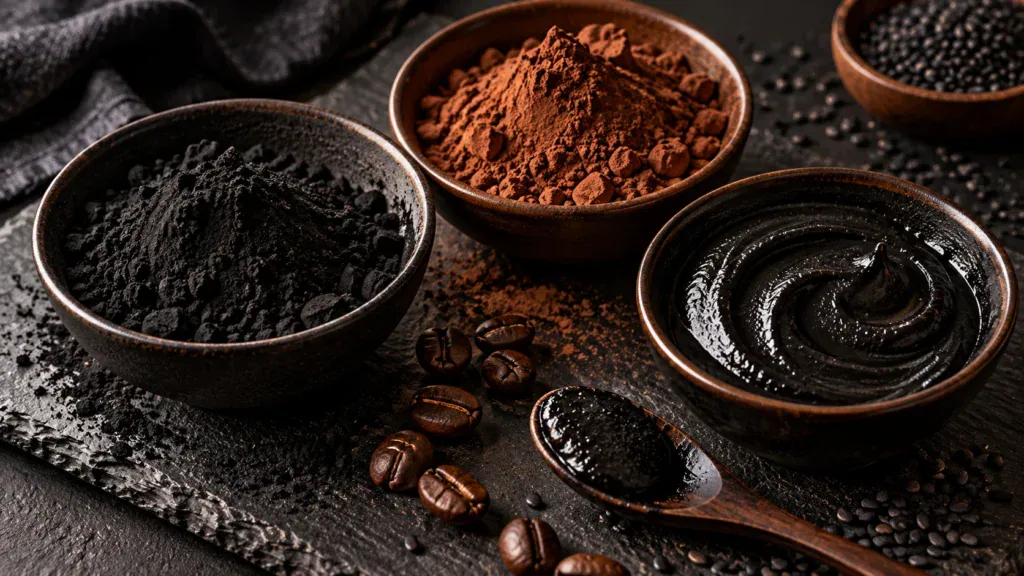
Black cocoa is cocoa powder that has been alkalized much more heavily than normal Dutch-process cocoa. This process darkens the color all the way to black and softens the acidity.
For a latte, that is exactly what you want:
- it colors the drink without making it sour
- its earthy chocolate flavor pairs naturally with espresso
- it dissolves smoothly in hot coffee
The flavor is mild and slightly bitter, a bit like the dark wafer of a sandwich cookie. A little sweetener and a pinch of salt make it taste rich instead of flat. Our guide to salt in coffee explains why a pinch of salt softens bitterness.
You can find black cocoa in baking shops or online. Look for labels like “black cocoa,” “black onyx cocoa,” or “ultra-Dutched cocoa”. I use Anthony’s Organic Black Cocoa, and one bag lasts me a whole season of lattes and Halloween baking. In my opinion, it’s the single ingredient that makes or breaks this drink. Regular cocoa simply won’t get you there, no matter how much you add.
My Test: How Much Black Cocoa Does It Take?
I made five black lattes side by side to find the sweet spot between color and flavor. Same espresso, same 200 ml of milk. Only the amount of cocoa and the type of milk changed.
| Black cocoa | Milk | Color | My verdict |
|---|---|---|---|
| 1 tsp | Whole | Dark gray-brown | Tastes fine, but looks like a regular mocha |
| 1½ tsp | Whole | Charcoal | Good color, mild chocolate flavor |
| 2 tsp | Whole | Near-black | My pick for dairy, needs a bit more syrup |
| 1½ tsp | Barista oat | Darker than dairy | Best balance of color and flavor |
| 2 tsp + 1 drop gel | Whole | Jet black | The photo-worthy one |
1½ teaspoons with barista oat milk, or 2 teaspoons plus one drop of gel with whole milk, gave me the blackest cup that still tasted like coffee, not like hot chocolate. I think oat milk is the underrated trick here. It’s naturally a bit darker and less “milky white” than dairy, so the cocoa has less work to do.
Why I Skip Activated Charcoal
Many viral black lattes are colored with activated charcoal. It gives a striking jet-black color, but I don’t use it at home, and I wouldn’t serve it to guests.
Activated charcoal is designed to bind substances in the gut. According to University of Utah Health, it can also bind to nutrients and medications you have taken, making them less effective. The UK medicines regulator, the MHRA, has also noted that charcoal can reduce the absorption of other medicines.
That matters when you’re serving guests. You don’t know who takes daily medication, including birth control, and I’d rather not find out the hard way.
Charcoal also adds nothing to the flavor and can leave a slightly gritty texture. Honestly, black cocoa gives you a beautiful dark color and a better-tasting coffee, so I don’t see a reason to take the risk.
Witch’s Brew Black Latte Recipe
This recipe makes one 300 ml (10 oz) black latte. It takes about five minutes.
Ingredients
- 1 double shot of espresso (about 36–40 g), or 60 ml very strong coffee. A dark or medium-dark roast works best here.
- 1½ to 2 teaspoons black cocoa powder
- 2 to 3 teaspoons maple syrup, sugar, or vanilla syrup. Monin Vanilla is my go-to because it rounds out the cocoa bitterness.
- 1 tiny pinch of sea salt
- 200 ml (about 7 oz) milk. Whole milk or barista oat milk froths best.
- Optional: 1 small drop of black food coloring gel for a jet-black color
Equipment
- espresso machine, moka pot or AeroPress
- steam wand or a handheld milk frother
- small whisk or spoon
- a dark mug, if you have one
No espresso machine? I tested this with a moka pot too, and once the milk and cocoa go in, it’s honestly hard to tell the difference. If you are thinking of upgrading, see our picks for the best coffee machines under $200.
Step-by-step
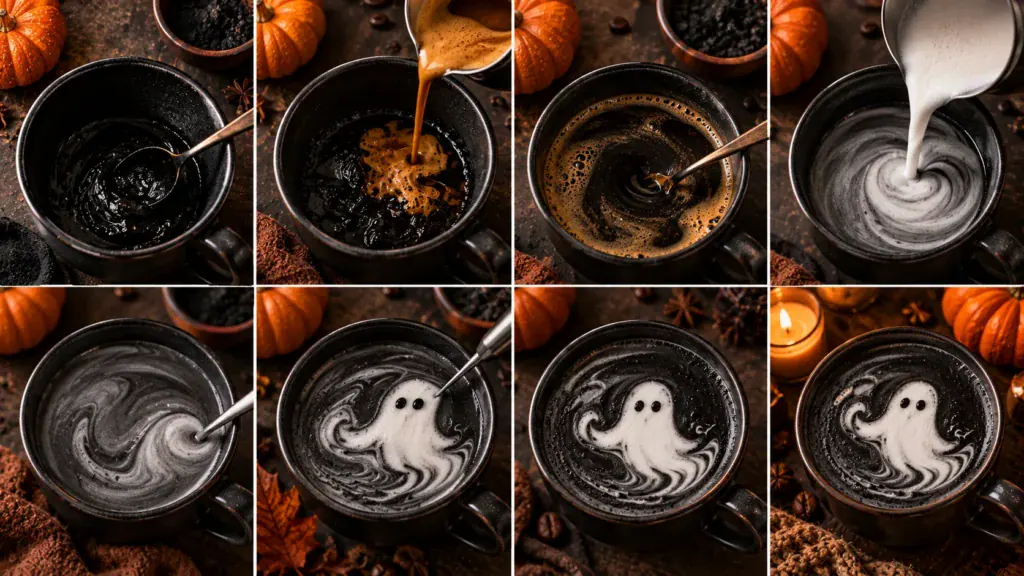
- Make the black base. Add the black cocoa, sweetener and salt to your mug. Pour in a splash of the hot espresso and whisk into a smooth, glossy paste with no lumps.
- Add the rest of the espresso. Stir until the base looks like dark ink. Add the drop of food gel now if you are using it.
- Steam the milk. Heat it to around 60–65°C (140–150°F), until the pitcher is hot but not too hot to hold. Aim for silky microfoam, like for a regular latte.
- Darken the milk (for a fully black latte). Pour about two-thirds of the milk into the mug, stir well, and check the color. Keep the remaining foam white if you want latte art.
- Finish with foam. Spoon or pour the reserved white foam on top. Draw a simple ghost, spiderweb or moon with a toothpick.
- Serve immediately. Black cocoa looks darkest while the drink is hot and freshly stirred.
New to steaming milk? Our step-by-step guide on how to make a latte at home covers frothing with and without a machine.
Black Latte Variations and Spooky Serving Ideas
Once you have the black base, you can change the flavor and the look for any Halloween mood.
Flavor variations
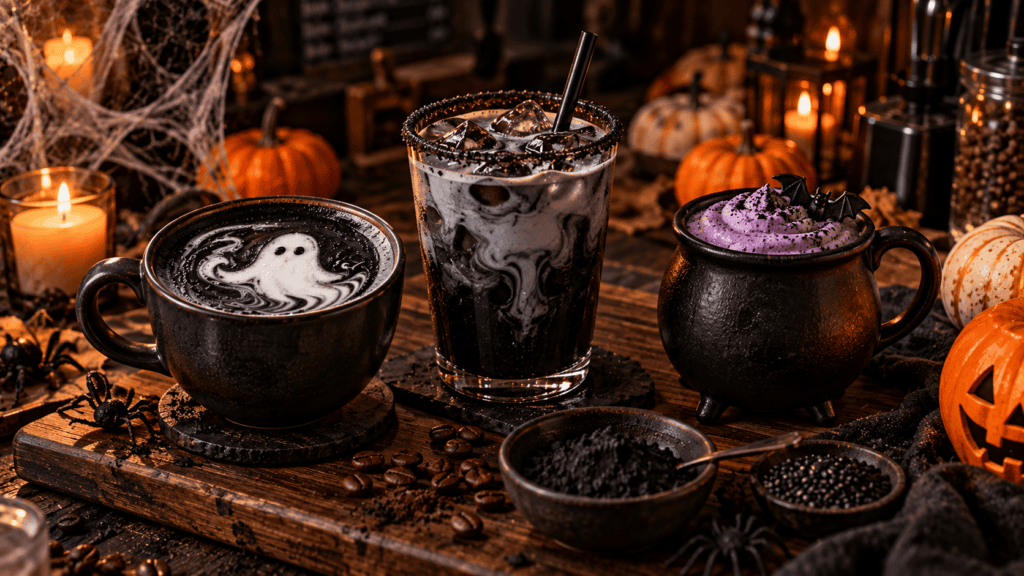
- Iced Witch’s Brew. Mix the cocoa paste with espresso, stir in cold milk, and pour over ice. Shake it in a jar for a darker, more even color.
- Black Vanilla Latte. My personal favorite. Use vanilla syrup plus a few drops of vanilla extract for a dessert-like cup.
- Midnight Mocha. Add 10 g of melted dark chocolate to the base for a richer, thicker drink.
- Black Velvet Oat Latte. Barista oat milk keeps the drink darker than dairy and adds natural sweetness. In my test, this was the easiest way to get a deep color without extra gel.
- Sugar-free black latte. Swap the syrup for a sugar-free vanilla or caramel. See our best sugar-free coffee syrups.
Spooky ways to serve it
- Ghost foam. Leave a little white foam aside and spoon it on top as a small ghost. Add two eyes with a dot of black cocoa paste.
- Spiderweb. Draw a spiral of white milk foam on top, then drag a toothpick from the center outwards.
- Black sugar rim. Mix 1 tablespoon of sugar with 1 teaspoon of black cocoa, dip the rim of the glass in syrup, then in the mix. It takes 30 seconds and uses what you already have, and honestly, I think it looks better than store-bought black sugar.
- Purple foam. Tint the cold foam with a drop of purple food gel for a witch’s potion look.
- Cauldron cups. Serve small portions in black espresso cups or mini cauldron mugs at a Halloween party. Smaller cups also mean less milk, so the color stays darker.
Looking for more spooky drinks for the same party? Pair this with our Halloween coffee recipes, like the ghost latte and dark forest affogato.
Black Latte Troubleshooting
Most black latte problems come down to too much milk, too little cocoa, or lumps. I ran into almost all of these while testing, so here’s what actually fixed them.
| Problem | Why it happens | Fix |
|---|---|---|
| Latte looks gray, not black | Too much milk for the amount of cocoa | Add ½ tsp more black cocoa or use a smaller cup with less milk |
| Still not black enough | Black cocoa gives charcoal, not pure black | Add one tiny drop of black food gel |
| Lumps or dry specks | Cocoa added straight to milk | Always whisk cocoa into a paste with hot espresso first |
| Tastes flat or bitter | Black cocoa is mild and slightly bitter | Add a little more sweetener and a pinch of salt |
| Color fades as it cools | Cocoa settles to the bottom | Stir before serving and drink while hot |
| Foam turns gray | Foam mixed into the dark base | Hold back some white foam and spoon it on last |
Black Latte FAQ
A black latte is espresso and steamed milk colored with a dark ingredient. At home, the best option is black cocoa powder, sometimes boosted with a drop of black food gel. Many cafés use activated charcoal instead.
Yes, slightly. Black cocoa adds a soft, earthy chocolate note, a bit like a dark chocolate cookie. With a little sweetener, it tastes like a mild mocha.
Yes, it has the same caffeine as the espresso you use. Black cocoa adds only a small amount. For a caffeine-free version, use decaf espresso.
Yes. Use 60 ml of very strong moka pot, AeroPress or French press coffee instead of espresso.
It can reduce how well your body absorbs medications and nutrients. That’s why I recommend black cocoa instead, especially when serving guests.
Yes. Black cocoa is naturally plant-based. Use barista oat milk and a plant-based syrup.
